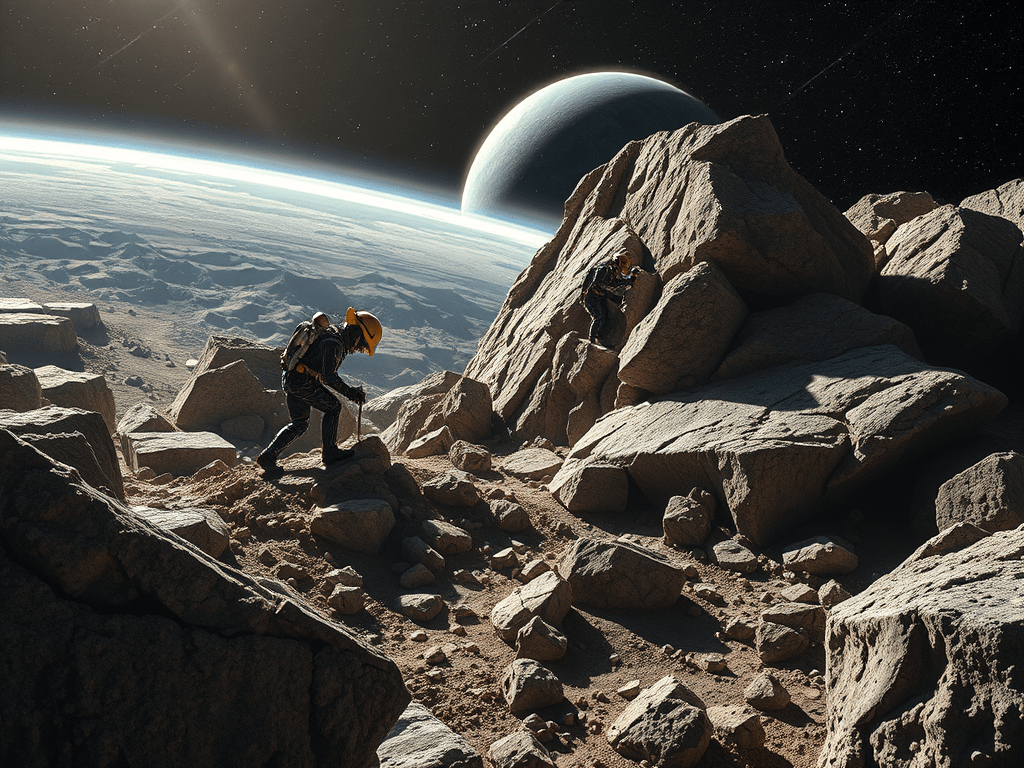
Tight Beam Volume 22, October 5th 2025. Mining operations and difficulties in zero gravity or operations on microgravity/ tiny objects.
Hello! Welcome to Tight Beam, the official newsletter for The Descendant Saga, and happy October! Here in part one, a quick update on what we accomplished during the month of September. At NSC we continued recording and editing for Audiobook of the second book in The Descendant Saga Series, Cave in the Sky. Our author had some major life changes in the middle of September, so progress has taken a nosedive, but that’s the dues we must pay, and progress does continue. With 18 chapters recorded AND edited, we are now exactly 50% complete (by page count) with the audiobook.
In the second part, our goals going forward… For the month of October, we plan to continue work on the audiobook. As many people know, Windows 10 technical support from Microsoft ends on October 14th (or 15th?) which is only a few days from this posting. We plan on continuing work on the audiobook, and completing it as soon as possible, so book II Cave in the Sky can be published (in E-book, Paperback and Audiobook formats, all at the same time) as soon as possible and then after publication, we can migrate our computer systems off of windows 10 and onto whatever flavor of Linux takes our fancy. Where we will the begin work for editing and recording of the third book in The Descendant Saga Knowledge of the Gods. Hopefully, that will make the transition a little more seamless, rather than doing it in the middle of the process of creating a book. Who knows if that will be completed before the end of October, or if it will be sometime in November, but that’s the goal, and we’re going to work towards it with the same singular focus we work towards everything, and it will be done, as soon as we are humanly able, Next book just in time for the Holidays 2025!.
In part 3 of this months article, it is a little longer and a little more technical than usual, our author Chace talks about not the story behind humanities expansion across the solar system in The Descendant Saga, but the likely real world technical difficulties and challenges humanity will have, accomplishing the asteroid mining and solar system spanning network of infrastructure needed to accomplish the simple task of “harvesting resources with asteroid mining”. If you like this content, or the books in The Descendant Saga (which have fewer info dumps in them, we promise) perhaps you would like some merch to go with your science fiction, support Nerd Smith Consolidated LLC and our star sci-fi author Chace by getting stickers, posters or perhaps something 3D printed from out Etsy Shop. Who knows, we may even do a special product run this month for spooky season. We do have a lot of black filament. As always, please subscribe to this newsletter so you don’t miss future posts with more updates, lore drops, world building and hyper nerdy info dumps like this one.
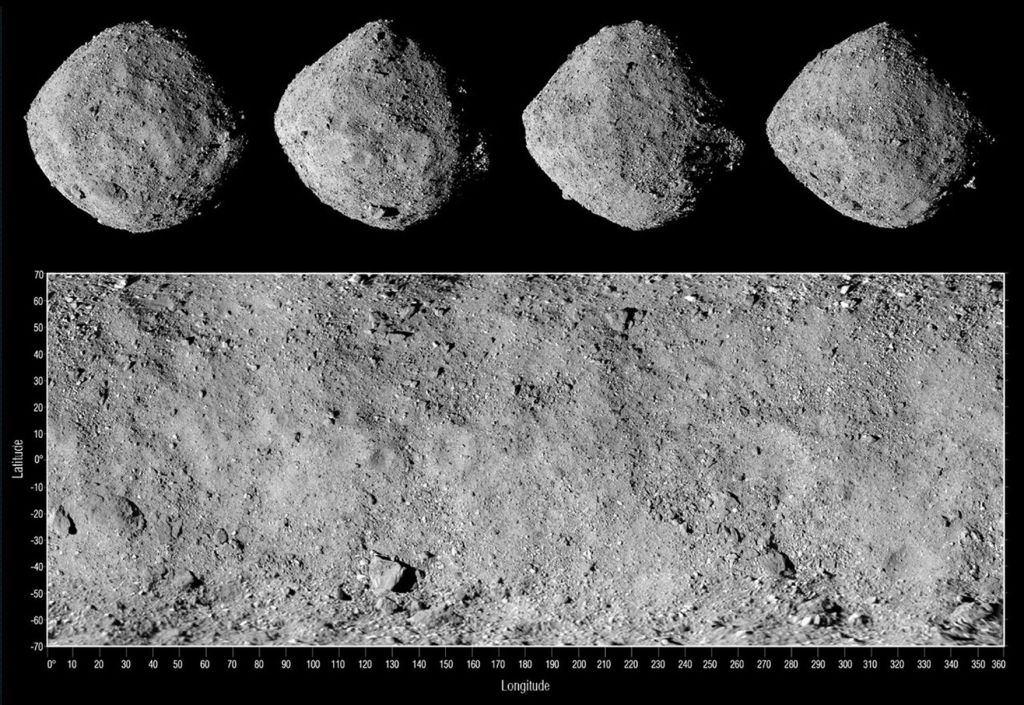
Hello internet, Sci-fi author Chace Randolph here, self proclaimed nerd, here to talk about something very nerdy. In the previous couple newsletters, We posted time lines, for events in The Descendant Saga. One of those pivotal events is the space race between the Russian origin European Federation and the Chinese origin Asian Australian Collective Republic./ During this space race, those two governments race across the solar system to claim and mine resources from various celestial bodies. Spreading in the rough order from earth to 1. The Moon, 2. Mars, 3. Venus, 4. Near-Earth Objects, 5. Mercury, 6. Earth/Mars Lagrange points, 7. Asteroid Belt, 8. Galilean moons, 9. Objects like dwarf planets and major moons such as Phobos, Ceres and Titan for example, 10. Outer system objects like comets and other TNOs (Trans Neptunian Objects) Below are some technical answers for questions on how this could/would actually be achieved.
Types of materials they’re looking for.
C-type asteroids (75% of know asteroids hydrogen, helium, water ice and such volatiles) S-type asteroids (17% of asteroids with metal deposits like iron, nickel, cobalt, magnesium) M-type asteroids (who contain the expensive metals like the platinum and derivatives or gold.) Most commonly there will be water ice other volatiles (zinc and carbon monoxide mostly) and metals like magnesium, iron, nickel, cobalt, gold and platinum group metals (ruthenium, rhodium, palladium, osmium, iridium and platinum) These meals are resistant to wear, corrosion and tarnishing, with high temperature resistance and stable electrical properties. Making them good for things like electronics, jewelry and fine medical tools like dentistry and surgical, cancer fighting drugs and wear resistant spacecraft hardware.
How to get to and from these objects?
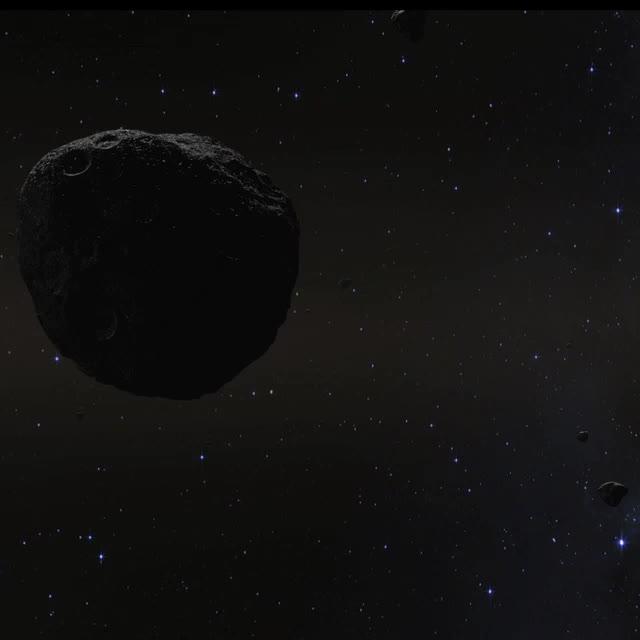
There are objects worth mining, or at least investigating, all over the solar system. But in order to accurately investigate them, we have to get probes to them. There’s three types of trajectories likely to be used to get probes and drones out to these objects in the asteroid belt (region of space further away from the sun than Mars, but inside the orbit of Jupiter where most of the asteroids in the solar system reside), or further out towards objects like centaurs (comet like objects whose eccentric orbits have been influenced and circularized into more stable orbits in the region between Jupiter and Neptune), trans Neptunian objects (A small number of objects that can be of moderate size and bare unique characteristics and eccentric obits with resonant frequencies compared to Neptune’s orbit. Nominally having their oval-shaped obits approach the sun closer than Neptune does, and the maximum distance from the sun deep out into the outer solar system far beyond even Pluto.) and Kuiper belt objects (a larger, much more sparse asteroid belt beyond Neptune extending to the edge of the solar system including large objects such as dwarf planets like Pluto, Orcus, Makemake and other more typical asteroid and comet like objects extending into the scattered disc out to the heliopause where the suns solar pressure has dissipated enough to be indistinguishable from interstellar space, effectively leaving the solar system.)
The three principal methods for getting out deeper into the solar system beyond the Earth’s moon. The first and most fuel efficient of these methods is called the Hohmann transfer, and would be the most likely method to get anything from Earth out to Mars and the inner asteroid belt. Simply put, a Hohmann transfer starts with the object in low Earth orbit, the object fires a thruster, accelerating into an eccentric orbit. If timed correctly, the high point of this new oval orbit would be near Mars or the asteroid belt object you which to prospect or operate at allowing that objects gravity to become the predominant local influence, where the probe could decelerate and circularize into a new orbit around the target object. The hard part is timing this transfer orbit so that the object you are targeting, such as Mars, is at the high point of your orbit at the same time your spacecraft actually reaches that high point.
The second method would likely be the primary method for reaching the more distant objects, such as the Trans Neptunian or Kuiper Belt objects. These objects are far away, and will take a long time to get there, no matter what you do. So, the most efficient way to get out to these great distances, the best bang for your buck so to speak, is known as a “Gravity Assist” much like the Voyager 1 and 2 probes did. The gravitational assist, also known as a gravitational slingshot, can be used to change velocity and trajectory of the spacecraft. This is done through the use of an existing celestial body i.e. Jupiter in the case of Voyager 1. This is possible through the conservation of momentum. The spacecraft (Voyager 1 in our example) approached the celestial object (Jupiter) and departs from that object’s sphere of gravitation influence at a 90-degree angle relative to the direction it approached from. Where the gravitational field of the object (Jupiter) imparts some of its kinetic energy onto the spacecraft (Voyager 1) and because of Pythagorean theorem the space craft accelerates by necessity to make this 90-degree turn, shooting off in the new direction at a greatly increased velocity without the expenditure of fuel. Again, the greatest difficulty of this is timing, getting the spacecraft in the right place at the right time relative to the object you are attempting to slingshot from. The best way I can think to describe this simply is to think of a person running, sprinting down the sidewalk at full speed, and as they reach the intersection they stick their arm out and wrap it around the light pole at the intersection, letting their grip on the pole (or in this case the planet’s gravity gripping the spacecraft), change their direction of travel by ninety degrees. This change in angular momentum by necessity requires an increase in velocity. And because we’re operating in the vacuum of space, rather than running on the sidewalk, the spacecraft can continue at this new increased velocity on this new trajectory, without losing the velocity it gained by performing the sharp turn.
The third and final method would be the most daring, known as an Oberth maneuver. It’s much like a gravity assist, but powered with engines burning. In the earlier example, of Voyager 1 sling shotting off of Jupiter, if Voyager 1 had an engine onboard, and fired that engine, accelerating down Jupiter’s gravity well as it approached, thereby increasing the input velocity, and through the aforementioned Pythagorean theorem and conservation of momentum multiplying the exit velocity by the same margin. This is more difficult not only because of the expense and complexity of having an engine onboard the spacecraft to do it, but because you’re accelerating down the gravity well, it will also bring you closer to the object you are sling shotting off of, and if it’s something large like Jupiter or the sun its self, this can expose the spacecraft to powerful forces, not just more gravity but heat, radiation even atmospheric in extreme examples. But if the ship can handle it, it’s worth it. A simple explanation is that if you have a speed of 1 and get an acceleration of 1.6 from the gravity assist, your new ship velocity becomes 1.6. But if you perform a powered Oberth maneuver and accelerate the ship to a speed of 1.2 and this new accelerated speed is multiplied by the 1.6 effect of your gravity assist your new speed is now 1.2 x 1.6 = 1.92 so while it takes more effort to input from the gravity assist, the right input at the right time, can have an even greater output than a simple gravity assist alone. This is probably how we would get spacecraft to the most distant of objects, like comets in their eccentric orbits. For the mining probes, unlike Voyager are going to have engines onboard in order to decelerate and rendezvous with the potential mining object in question.
How to get there faster?
Well, as I just said, probes are likely going to require onboard power plants, and while currently the most energy dense method, chemical rocket engines aren’t always the most efficient, especially for deep space operation, where larger quantities of fuel are needed. It becomes impossible to fly the spacecraft based off of just how much fuel it would have to carry, eventually, the mass of the fuel can outweigh the engine’s ability to shift that mass. Probable and mining drones would probably use things like VASIMR engines or ion thrusters for deep space operations or even laser propulsion for smaller prospecting vehicles on flybys.
VASIMR, or Variable Specific Impulse Magnetoplamsa Rocket engines, use radio waves to heat an inert propellant into a plasma and then use a magnetic field to direct that plasma into a thrust vector. Think of the engine like a microwave, and if you microwave your food hot enough, it will eventually explode. That’s much what a VASIMR does to its fuel, blasting something inert into plasma. And then, using magnets to A. prevent the plasma from touching and destroying the engine and B. vent the plasma in a singular direction to create thrust. Like putting a funnel over your microwaved cup of soup until the exploding soup is forced to vent out the tip of the funnel.
Ion thrusters work much the same way, except without the plasma. Using an electromagnet to accelerate an already ionized gas, taking advance of the electric fields of that gas, such as hydrogen, argon, nitrogen or ammonia gasses to accelerate it in a specific direction, creating a thrust vector. This is also a simpler, inert one part fuel, aka mono propellant when compared to traditional rocket combustion engines.
Both VASIMR and ion engines have high efficiency and high exhaust velocities but, by their design, a low specific impulse. Comparable to a car engine with lots of horsepower but very little torque, it has a high maximum speed but will accelerate very slowly. However, for probes headed to the outer solar system like trans Neptunian or Kuiper Belt objects, that’s fine, the fuel efficiency of these engines lets you accelerate with the ion thrusters the entire time. Engine burn times would be for weeks or months rather than minutes or hours afforded to us by typical chemical combustion rocket engines.
Laser propulsion is even more efficient as the spacecraft being accelerated by the laser does not carry the engine or fuel. Earlier I mentioned light pressure from the sun equalizing with the ambient pressure of interstellar space, marking the edge of the solar system in a region known as the heliopause. Well, light pressure exists everywhere, and though a tiny force, it is a force, and that force can be used to propel spacecraft. Tiny probes used for flyby scanning and prospecting could be propelled vie this method. In example, a facility on the moon, equipped with a powerful laser powered by as nuclear reactor could aim the laser at the small spacecraft which is equipped with a light sail, which is much like a solar sail, but this catches the focused energy of the laser beam, and that light pressure accelerates the tiny spacecraft. That way, it could accelerate into the Hohmann transfer orbit without having to have an engine of its own mounted onboard. Reducing cost, complexity and so on, allowing this single laser station on the moon to propel many small spacecraft. And solar sails could be used (and have been used) on small spacecraft with massive super thin lightweight sails, to use the light pressure from the sun to propel the spacecraft, much like an actual sail ship from the 16th century. Just this time instead of using Earth’s atmospheric wind, it’s using the wind of the sun’s light pressure to push the spacecraft, no laser needed. Excellent for long duration deep space missions, and still offering more speed than probes like Voyager 1 or 2 that don’t have onboard propulsion systems.
Do spinning asteroids need to be nullified so that they are no longer spinning before mining them, or how can a spacecraft land on a rapidly spinning object such as a small asteroid?
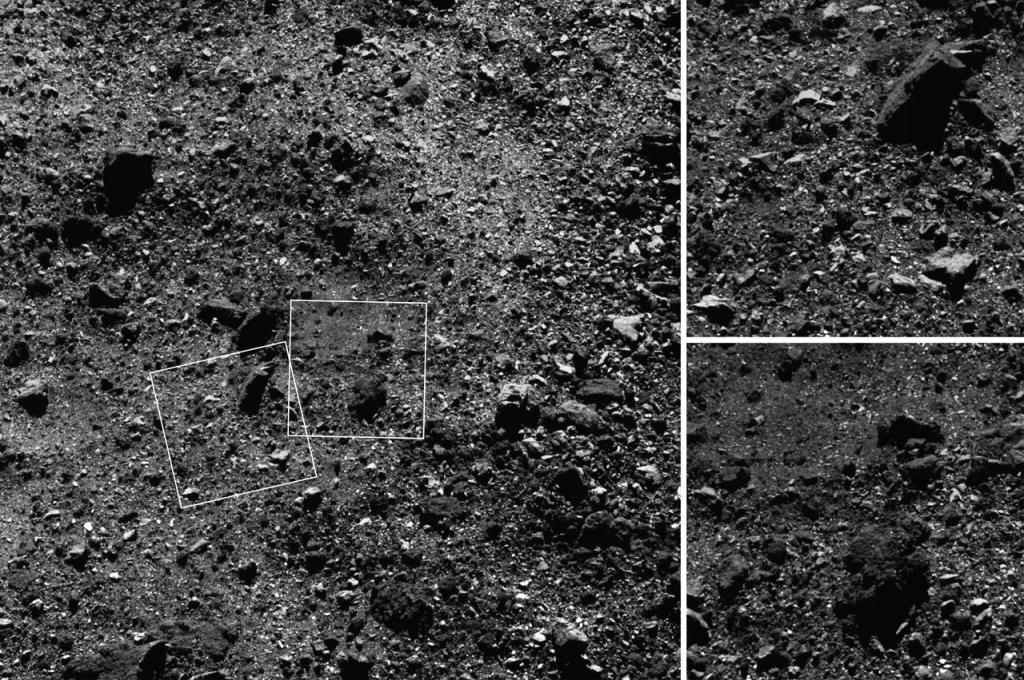
The difficulty of landing on a fast spinning asteroid is twofold, because not only is it spinning quickly, but they have little gravity due to their small size. Because whatever space craft, be it a prospecting probe or a mining drone needs to grapple with the object to secure itself to the asteroid so it doesn’t drift or bounce off during operations or attempted landing, and that’s pretty hard to do when the asteroid is spinning. Some rubble pile type asteroids may spin so fast they’re actually pulling themselves apart as the surface rotates at a greater speed than the escape velocity of their meager gravity. What’s more, depending on the size of the spinning object in question, the terrain itself may become the hazard, hard to land when a mountain comes flying over the horizon and smashes into you.
Sure, you could fire a harpoon into the object (if it’s dense enough to remain lodged in it, but not too dense that it simply bounces off solid rock) and let the spinning object wind up the cable around it, pulling your probe down to it, but that might create too much angular momentum and smash the space craft down into the surface too hard, and with the unpredictable terrain, it would still be dangers even if mathematical plausible. Perhaps, a probe could clamp on and use an engine to decelerate the rotation so mining equipment could attach and go to work, but depending on the mass of the object, the fuel expenditure to slow or stop the rotation might not be worth the materials inside. In some cases it may be possible to match the lateral speed of the surface as you descend for touchdown, but that’s also relative, depending on the local gravity or the surface speed, that lateral motion may well exceed escape velocity.
The best approach, but again not always practical depending on orientation and location within the solar system, but the best method may be to align the spacecrafts center axis with the asteroids axis of rotation, that way the spacecraft can then be spun around the same axis, at the same rotational speed, nulling out the relative motion between the two objects, and all it has to do is descend onto whichever of the two poles it’s approaching, and then clamp on, and deploy its tools, probes rovers or whatever equipment it has brought to do its job. While the best solution, that’s only feasible if you can get into a polar orbit around the object in question, and then you’re limited to landing in those two zones. Hopefully, the landing sites are empty and the resources you’re after are close by. Imagine if spacecraft could only land at the North and South pole of earth, be pretty hard to get any mining done from there…
Deep space electrical power, when are solar panels no longer viable, other electrical power plants?
Solar panels are great, they’re light and mechanically simple ways to generate electrical power in space, provided you also have at least some sort of onboard batteries and can keep the solar panels pointed towards the sun. However, as the probes, prospectors and spacecraft get farther from Earth, farther from the sun, the solar panels become less and less effective. For example, solar panels on Mars only receive about 45% ish percent the amount of light that they do as compared to Earth. And most of the objects we’re interred in mining are in the asteroid belt, even farther away than Mars. How far away can we continue operating spacecraft on solar panels? For many of the simply spacecraft for prospecting and claim staking spaces in the asteroid belt, their electrical power requirements are low enough that with some good batteries and appropriate sized solar panels, it’s probably still a cost effective option but for spacecraft that are going to go deeper into the outer solar system, prospecting gas giants’ moons, Plutinos or trans Neptunian objects, the sola radiation will be too weak to generate adequate power, and for other craft, like landers and rovers. The machines that will be doing the actual mining and processing, not just the prospectors, they’re going to require a lot more power, and even in the asteroid belt, they may not collect enough energy to operate as the situation dictates.
For operations deeper in the solar system, or for things with more intense power demands, alternate power sources will be required. One of the best options on paper is to use RTGs or radioisotope thermoelectric generators. Simply put, they have some radioactive components onboard, and that radiation degradation generates heat, and that heat can be converted into electricity. They’re simply mechanical and can provide stable, reliable power output for decades. This is how the Voyager 1 and 2 probes are powered. They were launched in 1977, and while in reduced states, they’re still operating nearly 50 years later. The biggest limiting factor on those is that they run on radioactive fuels like plutonium 238, which, due to politics and nuclear nonproliferation, is a rare and expensive fuel. Perhaps in the future, it won’t be such a taboo anymore, especially for private organizations and corporations, rather than government entities like NASA, who built and launched the Voyager probes.
Fuel cells, like those used on the Apollo missions, are great, but not practical for mining missions that may last for years or decades as spacecraft roam deeper into the outer reaches of the solar system. They won’t last that long, they do make decent power output, and perhaps modern, more advanced systems could be used in hybrid with RTGs, a smaller cheaper RTG can power the spacecraft as it heads to its destination, and then once it reaches the asteroid or comet it is to be mining, it can activate the fuel cells, to put out higher amounts of power for shorter durations while it’s actually doing the mining, and then shut the fuel cells off during the return journey where low draw systems can run from the continuous power of a lower output RTG, so once the spacecraft returns with its harvested materials, it can be serviced or refueled before being deployed for its next target.
For larger systems, entire reactors could be used. Reactors are being made pretty small these days, and in the next 80 to 100 years when this hypothetically is taking place, I’m sure the packages will only get smaller, and the power output greater between now and then. The power output wouldbe limited by the size of the reactor, but then you simply size the reactor you need to power demands of the operation and for larger mining drones that will either service multiple targets, or have separate space craft take its output and return it to the hub or earth. Perhaps the hubs themselves are powered with reactors. Of course there’s going to be various battery and capacitor banks too in integrated systems, that will help with power spikes and instantaneous demands, but those are probably going to be the best bang for the buck barring some wild technological development no one can predict.
How to handle malfunctioning equipment and the chain of custody from the asteroid back to earth? (Hub stations, logistics, deep space network, manned and unmanned positions)
There would undoubtedly be an enormous network of systems, be they space stations, repair depots, zero gravity factories, or simple communications relays. I’m going to start at the edge of the solar system and work toward the Earth, in a rough outline of what I would expect there to be for infrastructure across the solar system. Out at the edge of the system would be smaller probes and drones. Things that are cheaper to build and launch, and can move faster, became the distances are huge. It might be 20 years or before you get a return from a specific chunk of rock. Launch a small, fast prospecting probe with some sensors and an impactor to do a flyby. It takes 8-15 years to reach the target, do its survey and send info back. So now you can launch the mining robot. It’s a little bigger, and will take longer to get there, it’s heavier, has to have a more carefully coordinated flight plan and orbit, the object you’re targeting might be closer or further away by the time you get there so that’s another 8-15 years, depending on your luck, if the target is even worth going to. (These speeds are ballpark estimates based on transit times of current space probes like New Horizons probe to Pluto, for example.) So then it gets there, and it takes weeks, months maybe years to mine the materials, and or process them, and or send them back towards the inner system. Sure, the return journey will be faster because you’re falling down the gravity well towards the sun, rather than climbing out of the pit, but still it is an enormous distance and liable to take another 5-10 years. So that’s something like 20-40 years from the time the miners decide to target the asteroid, vs the time they get the ore back from it.
No one wants to invest like that on generational timelines. I know big corporations will, but they’re still going to do everything they can to accelerate it, faster supply chains mean more cash flow. So, starting with those small to medium-sized prospectors and mining robots in the outer system, there’s probably going to be some autonomous stations out there beyond the asteroid belt. Jupiter has a nice big gravity well and is liable for there to be an unmanned service station in orbit. Most spacecraft traversing the asteroid belt to the outer solar system are probably going to use Jupiter for a gravity assist or otherwise. This makes it a good spot to put a service station, or several, where these deep space drones can return and launch from. They can drop off their payloads, get refueled, swapped out worn of malfunctioning modules and tools for new ones, and so on. This is a fantastic location because with so many moons around Jupiter, there’s going to be tons of resources up for grabs there. Tons of things going to and from these moons, processing raw materials, refining water ice into fuel, skimming from the trace atmospheres for things like argon or nitrogen to use as fuel for efficient thrusters like MPDs and Ion engines. This unmanned station (or more likely dozens of stations as each government and corporations tries to service their own equipment, or have multiple robo stations to service the growing fleet as every scrambles to get what they can before someone else does.) What materials aren’t used there, because those places are going to have not just spare parts and fueling stations but some limited manufacturing ability. They have to make those ports, and with things like 3D printers, it’s only going to get easier and easier to manufacture a variety of complex parts with limited machinery in remote locations. But they’re not going to use everything, and some cargo tugs are probably going to be used between these unmanned stations and the farthest out manned stations, which I expect to be hanging out around the Lagrange points of Mars. Because of the different orbital periods between Mars and Jupiter, the launch windows of these supply tugs from the Jupiter stations to the manned Mars stations will probably come and go in waves as the launch window for the shortest duration trips opens and closes. That area is probably the furthest from the sun where solar panels are worth the investment.
At these Near Mars stations, since they’ll most likely have human crews, they’ll do more extensive repairs and construction. Not just replacing modules or worn tool heads but building whole new probes and spacecraft, as well as receiving and processing the unused resources from the outer system, be it water ice, minerals, rare earths, raw ore, or something else we haven’t even discovered or could predict yet. Mars will have its own local economy with its moons, space stations and surface colony(s) so it will be a major hub, supported by the input from the outer system, and don’t forget, the asteroid belt itself. The asteroid belt between Mars and Jupiter the default dividing line between the inner and outer solar system, is where the most asteroids are, where the most work will be done. All the probes, prospectors, impactors, drones, robots and perhaps even manned missions will focus there, bouncing to and from these asteroids as mars moves through its normal solar orbit, letting the infrastructure graze across the pastures of the asteroid belt, without stripping a specific region bare ever a few short years. Some things would be sent down to the colonies directly on Mars. They’ll have even more manufacturing and processing power there, real factories, smelters and all the heavy industry we are familiar with here on Earth. Sure, there will be less of it, but it will all be new designs, more efficient, not still running on centuries old steam engines like some of our stuff is here on Earth. Most of that, if not all would be used locally though. If you’re going to send it down the gravity well, through the atmosphere, to the surface of Mars, it would be pointless if that material was intended to be sent back up, waste of fuel and resources to claw it back out of the gravity well again.
But things will keep trickling down. What’s pulled out of the asteroids, be the from the main belt or the outer system, and not used either on site, or for the growing industry on and around Mars, will trickle down to Earth. Mars to Earth is the short trip in this scenario, most likely more stations on or around the moon will be receiving the incoming materials, and sorting it, to use themselves, process into a final product to send down to earth, or at the bottom of the catch basin, the trickle down from the outer solar system, sending some raw materials down to earth. Each of these stations, manned or not, will probably serve as s relay too. The signal lag and attenuation for those deep space probes and worker drones can be pretty significant, and such relays may help with that. But don’t forget this works both directions, it’s a two lane zero gravity highway. Because this all came from Earth in the first place. The facilities on or orbiting the moon, on or orbiting Mars, around Jupiter and its moons, in the asteroid belt, drifting between the distant Plutinos and trans Neptunian objects. It doesn’t all make it back to Earth, much of it will get absorbed into the greater solar system-wide economy, but that’s exactly what it is, a new, massive economy where the governments and the massive corporations of the future, will look to make, another buck.
What about zero gravity manufacturing and processing?
Mining operations will be very different in space than they are here on Earth. Many of the machines, such as drills and scoops, will still be the same, but they’ll have to be applied in very different ways. On small asteroids on wide orbits, there will effectively be no gravity, so not only do you have to attach the probes and robots to the asteroid, but you have to brace them for the work, and provide counter torque gyroscopes and such. For small enough rocks, a process called bagging may be used. Where a giant trash bag is put around the entire asteroid, so as the operations are performed, no dust, rocks or volatiles are lost to the depths of space, it prevents debris, and improves efficiency. There’s no flow, so drilling and cutting tools that typically have lubricants are going to be hard or impossible, but without the resistance of gravity, it will make vacuuming up particles much easier too. Like with everything, there’s pro’s and con’s to it all. But those are both mining and manufacturing concerns, working with those kinds of tools, like drills. Other things like smelting and welding would be very different. Molten metal wont flow, and like water, due to fluid dynamics would be little floating spheres of “don’t touch” This would make somethings easier. Allows could be mixed perfectly, distributed evenly for things like casting and molding. But at the same time, it would be even harder to do casting and molding since there would be no gravity to force material to settle in them, and things like spinning furnaces or electromagnets would have to be used to control the flow in molds.
Making semiconductors in vacuum would obviously be easy, no need for clean rooms either, but that also means there’s no convection, and parts that need cooled or otherwise temperature controlled, will be harder to do so while making them. Hot spots stay hot, things wont dissipate, heat wont rise, cool air wont sink, but there’s other thinks, like increased precision, while you still have to deal with mass, you don’t have to worry about weight, making it much easier to maneuver and assemble components in a three dimensional space, even massive sections of space stations or orbital factories can be carefully moved and lined up. A short, good-bad kind of list, things like vacuum coatings, 3d printing, crystal growth, mixing alloys, avoiding contamination, and making semi conductors will be easier and better, and who knows what else we will develop and discover once we’re actually doing it, rather than just discussing theory. But some things will be harder, or worse. And tool must be anchored to something to apply force to something else, debris collection will be paramount, temperature management will be more difficult, and if people are doing the work its easier for individuals to get disoriented in zero gravity, even if it makes moving massive objects and aligning them much easier. There’s good, bad, and who knows what else we’ll discover, perhaps something ugly.
How to determine who owns what deep space objects, international property rights and territory in deep space? Governing and enforcement bodies and ownership by private corporations vs governments.
The value of the contents of asteroids is estimated to be $100 billion per person currently living on earth. There currently aren’t laws relating to such things, we have only the outer space treaty of 1967. The Space treaty of 1967 was signed by the UK, the USA and the USSR and says a few things. (“ The exploration and use of outer space shall be carried out for the benefit and in the interests of all countries and shall be the province of all mankind; Outer space shall be free for exploration and use by all States; Outer space is not subject to national appropriation by claim of sovereignty, by means of use or occupation, or by any other means, States shall not place nuclear weapons or other weapons of mass destruction in orbit or on celestial bodies or station them in outer space in any other manner; The Moon and other celestial bodies shall be used exclusively for peaceful purposes; Astronauts shall be regarded as the envoys of mankind; States shall be responsible for national space activities whether carried out by governmental or non-governmental entities; States shall be liable for damage caused by their space objects; and States shall avoid harmful contamination of space and celestial bodies.” per https://www.unoosa.org/oosa/en/ourwork/spacelaw/treaties/introouterspacetreaty.html )
In The Descendant Saga, there wouldn’t really be a body with the authority or the capability to enforce the laws, anyway. It boils down to a gentleman’s agreement between the EF and the AACR, where it works on a first come first serve basis, and things like impactors are used to literarily or figuratively plant flags on rocks to claim ownership, and because of th second cold war, the second space race, if they disagree, it could escalate to war, and through mutually assured destruction they cant go too war, so they find diplomatic solutions, negotiate, if you give us this rock, well give you that rock. Etc.
How can prospectors identify objects, and selecting candidates for further explorations/evaluations?
There’s a lot of different methods for evaluating potential targets, and I’m sure it will be don’t very thoroughly. Don’t want to spend the money and years of flight time for a robot to get out there, only to find out there’s nothing worth bringing back, and spending all the more time, and fuel to come back empty-handed. Starting with the things we can do from Earth to evaluate targets, there’s Telescopic Spectroscopy. Looking at the sunlight that is reflected from the object, the different wavelengths or colors of light that are reflected can help us determine what’s there, be it water ice, metal or some other silicates. Other factors, such as the brightness and colors, can give more general ideas about it, and if possible, infrared measurements can show hot and cool spots, allowing for density and depth to be estimated too.
Then there will be small, cheap scout probes, things commonly known today as cube sats. They’ll do fly bys to take images of surface features and measurements of things like gravitational perturbations. Being so small, not only do they cost less, but its easy to get them accelerated, and out to intercept targets. Magnetometers can detect metallic components if you get close enough, and radar can help determine density, it its a rubble pile or a solid rock. Important to know before you land on it.
Once a little probe has done a fly by, they may do actual prospecting. Be it a separate second probe, or the mining robot itself. Either way, It’ll land and anchor itself to the asteroid, where it will drill or scoop samples to analyze with onboard instruments, so it can measure things, and more accurately use spectrometers and ground penetrating radar for scans before starting work, perhaps moving too a different spot on the asteroid and working there instead, or abandoning it all together if it’s not worth the effort.
Other things that may be used are called impactors. A small fast probe, physically collides with the asteroid in question, and then ejecta from the impact can be analyzed to determine make up. This would probably only be done on large asteroids, as you don’t want to lose too much material on smaller ones.
Tugs may be used too. Rather than mining the asteroid where it is, a spacecraft with high efficiency engines like MPD’s or Ion thrusters can attach itself, and push the asteroid into a new orbit, where other machines, space stations or mining bots will better be able to access it. Might save time, either in getting there, or shipping back from it, or just to make the asteroid more accessible for valuable equipment you don’t want out of operation during long travel times to the edge of the solar system.
When humans do work instead of robots, can people even work on such tiny objects that they lack gravitational fields?
In practice, robots will almost always do the work, or at least go first. These are small and distant targets and it will be hard for people to get there and back, much less work on them. The radiation and repetitive tasks for who knows how long, makes it impractical, just unreasonable to send people to do the work.
People can do something robots can’t, or can’t yet, like problem solving, decision making, some complex maintenance and assembly tasks. If a robot fails perhaps a tug will push the asteroid and the robot to a place where humans can service it. Most likely, the human crew probably won’t venture beyond space stations, factories or foundries in the Martian L2 point. Perhaps, depending on the corporation, they may send humans on dangerous missions. You can always hire more workers, but if you lose an expensive robot, you have to pay for another one, in some ways, the machines are more valuable than the meat.
What new problems would we have to deal with for Drones with onboard tools? (How different operations in in zero G are.)
Onboard tools like scoops and drills will have to use counter torque mechanisms and legs or struts to brace against the motion and counterweights for robotic arms if needed. Once mined, other tools like centrifuges and magnets will be used to help separate and sort materials. The problem with using tools in zero gravity is, counter forces, ya know, Newton’s third law. Other problems, like I mentioned elsewhere in this article, are things such as dust and debris floating around, not settling. Picking up electrical charges and sticking to things because of static, clogging joints and whatnot. Beyond that, without an atmosphere, there’s no ambient cooling, and without gravity lubricants won’t flow, even for cutting tools like drills or blades, and will have to be pumped when required. Low speed, high torque drills and saws that don’t require lubricants would be even better, the tools themselves would likely still rely on other cooling systems like radiators and pumps. In rare, near Earth cases, sunshades could help keep them cool too. But these problems apply not just to the tool, but the entire system. In some cases, robots may have to work in short bursts rather than sustained operations so hardware can cool down or heat up, dust can be collected (or given time to settle if there’s enough local gravity). Other systems or processes to remove static fields and prevent or reduce clinging dust may be implemented too.
What about rendezvous and landing on tiny objects with no relative gravity?
Spacecraft approaching small objects, like asteroids, that are too little to have significant gravitational fields of their own, will have a hard time of it. Without a major gravitational field, you can’t orbit the object, so instead, the spacecraft’s best bet is to match its orbit with that of the asteroid, and then rendezvous with it like you would with another spacecraft rather than a celestial object same way the space shuttle used to match orbits with the ISS and then creep up with it to dock. And because of the lack of major gravity, it really will be more of a docking than a landing for whatever probes, prospectors or mining equipment landing on it. Without gravity to hold it down to the surface, it would have to grapple with it. Spacecraft would have redundant systems compromised of things like anchors, harpoons, claws, drills or clamps and hold themselves to the surface instead so they don’t bounce off on landing or drift off again once operations on the surface begin, such as scoops or drills for mining. Perhaps for objects known to be rubble piles, rather than singular objects, they may impact the surface with some relative speed and impale themselves into the regolith, rather than clinging onto it, depending on the density of the aforementioned rubble pile.
How to get refined materials back to earth? How much processing is done onsite, vs what is just harvested and brought back for processing later?
Because there is no atmosphere, materials are primarily sent to the moon, where it supplies the infrastructure there, and is processed, refined or used for orbital manufacturing, before getting sent down the gravity well to earth in a more finished state, delivering final products and the few things needed raw, such as water, directly to earth. Not everything will be sent back to earth, or even to the Moon or the various space stations and satellites sure to be in and around the Earth/Moon environment. Some things may be used directly. Water ice may be heated and, through a process of electrolysis, split into hydrogen and oxygen, where it can serve as rocket fuel. OR other things, such as rare metals like platinum or gold, can be used in zero G manufacturing, and perhaps they won’t make it back to earth, the moon, or the space stations depending on where the materials are harvested, if they’re out among the TNO’s (Trans Neptunian Objects) it may not be worth the fuel/ time to send them back to the inner system, especially if they can be used to build or repair spacecraft already out there, rather then hauling it back to earth. In this case, it’s more a question of where the mined materials are most likely to be used. If you’re automated facility near Neptune is building more probes, send it the materials, rather than spending the time and cost to ship it back to earth, build more drones and send them back out to Charon or wherever you’re prospecting at the time. For example, a mission from Pluto to earth and pack could easily be 15 years if not more.
How to make a profit doing it?
Now that I have explained all this, I’m sure some people are thinking something along the lines of “Sounds expensive on complex” how can anyone make a profit doing all that? Because let’s be honest, the world moves because of money. And if they can’t make a buck, no one is going to bother doing it. So let’s talk about how this deep space mining might actually make a profit for the governments or corporations that choose to partake in it.
Sure there’s ore, and that ore, those raw materials, be it water ice, methane, hydrogen, platinum, or something else, has a value but you have to go get it, but in order to go get it, you have to build infrastructure. And sure, while infrastructure costs money to build, it also can make money. Highways have tolls, space stations have leases. Once in orbit, everything gets much cheaper, those resources, the raw materials mentioned earlier, won’t be on earth, they’ll already be in orbit, therefore they’ll be cheaper, because you have have to spend the fuel, the rockets the support to launch them from earth into orbit.
It’s not just building profit, it’s building an entirely new economy. Think of aviation for example. The first few airplanes were expensive and limited in capability, but as airplanes became more common, and more airports got built, airplanes got more capable, an entire economy grew up around the air transport industry where none had existed before. So sure, there will be resources and raw materials mined, and those will be worth money, but then there will be the in orbit infrastructures built, and those will be worth money, and the in orbit infrastructures will mean in orbit manufacturing with those raw materials (There’s no point in sending it down the gravity well to earth’s surface, just to spend the fuel to launch it back into space.) It would be much cheaper to build the rockets in orbit to begin with, saving all the expensive of rocket launches into earth orbit, by not having them at all.
It’s not just “making a profit” it’s building a whole new economy, with new infrastructure, new resources, new technologies and trust me, the operations and the governments will find a way to make their money from it.
(Images in this post are credited to NASA)
 The Descendant Saga